Laws show what is acceptable behaviour so that people can live safely and without fear.
Laws are made by the government and can vary from country to country. For example in the USA you need to be 21 to buy alcohol but in the UK you only need to be 18.
What is a crime can change over time. For example, homosexuality was illegal in this country but is not anymore.
SIN
A sin is an action which goes against the will or the laws of God
Some sin are crimes, for example murder and stealing. Other sins such as adultery and pride are not against the law.
Crimes and Sins are about WHAT IS WRONG
HOW we decide what is right or wrong is known as morality.
Making decisions on how we should behave is very complex. Here are two simple common forms of morality you need to know about:
ABSOLUTE MORALITY
This is when a principle applies in all situations no matter the context or circumstance.
For example ‘stealing is always wrong’. It would be wrong for me to steal food, even if my family were starving.
Another example would be the belief that it is wrong to directly and intentionally take innocent life. This would apply in all situations, including abortion and euthanasia. There is no circumstance where it is acceptable. Taking a life in self-defence or in defence of one’s society, for example, in war, is not an exception to this ABSOLUTE MORAL PRINCIPLE
RELATIVE MORALITY
This is the idea that a moral principle can be adapted or adjusted in certain situations.
So stealing in principle is wrong, but if I have no other way to get food then stealing is acceptable.
I might think killing is wrong but if I need to defend myself then it might be reasonable to do so.
RED ZONE
List examples of sins that you know
List examples of crimes that you know
Explain, with the use of examples, the difference between a sin and a crime
Explain, with the use of examples, what is meant by ‘relative’ and ‘absolute’ morality
Do this for one word, then two, then three, then four etc until you can do it for all 8 words – WORD FOR WORD
Sin and Forgiveness Key Concepts:
Absolutism
The belief that there are certain actions which are always right or always wrong. The belief that moral laws exist eternally and are not just human inventions.
Eucharist
Meaning ‘thanksgiving’. The name Catholics use to describe the rite where the bread and wine become the body and blood of Jesus and are received by the people. Also the name for the Real Presence of Jesus in the Sacrament of Holy Communion.
Evangelisation
Literally means spreading the ‘Good News’ which can be translated as ‘Gospel’. The sharing of the Gospel and life of Jesus with others.
Forgiveness
The act of pardoning someone for the offences they have caused you. Overlooking a person’s faults.
Punishment
The consequences of a wrong decision and a penalty imposed by a person in authority on the person who has committed wrongdoing.
Relativism
The belief that there is no moral law and that rules that govern what is right and wrong are human inventions and change from place to place and form age to age.
Salvation
The belief that through Jesus’ death and resurrection humanity has achieved the possibility of life forever with God
David Hume is a humanist. He doesn’t believe in any God. For David Hume, as it is for many people, the problem of evil is so big that they reject God and the possible existence of a God altogether. To support his argument David Hume put forward the inconsistent triad. This three things (triad) which do not go together – not all of them can be true at the same time (inconsistant)
If God is OMNIPOTENT (all powerful) and BENEVOLENT (all loving) He would love us and have the power to stop evil and suffering. But as evil and suffering exists he either is not powerful enough to stop it or he doesn’t love us. Therefore God cannot be BENEVOLENT, OMNIPOTENT while evil and suffering exists within the world.
David Hume specifically uses this to argue against Natural Evil.
MORAL EVIL – This is suffering which is the result of human action. Examples are theft, burglary, terrorism, assault and murder
NATURAL EVIL – This is suffering shich is not to do with human actions, but with the way the world is. Examples are floods, volcanoes, cancer, disease and earthquakes.
Traditionally it is a lot easier to explain MORAL EVIL as it is a result of bad human choices. It removes the blame from God.
NATURAL EVIL is more difficult to explain. One explanation offered is the general laws argument: scientific observation means that there must be natural laws in operation. These laws describe inate processes and stresses such as, for example, stresses on the earth’s crust causing earthquakes.
The problem here is if God designed the world he designed it with these natural laws that cause suffering. Why?
Did he not love us?
Does he not have the power to stop these disasters?
David Hume would argue it is because God does not exist.
RED ZONE
Describe David Hume’s response to The Problem of Evil
Explain the concept of the Inconsistent Triad
‘The Inconsistent Triad proves that God does not exist’ Provide one religious and one non religious response to this statement.
‘The Inconsistent Triad proves that natural evil is caused by God’ Discuss this statement including arguments for and against.
St Augustine gives three answers to the questioning of suffering:
B – A – D
B – Better
St Augustine says God allows suffering because he is omnipotent and good. He allows evil because in his goodness and power he is always able to bring a greater good out of suffering. Suffering can be beneficial. He can make suffering better and we can end up better because of our suffering. This makes it a good thing.
A – Appreciation
St Augustine says that the existence of evil helps people to appreciate the good in the world. For example, being unwell helps us to appreciate when we are healthy.
D – Doesn’t Exist (PRIVATION)
St Augustine tells us that evil is just the absence of good things. This is called privation. WORD LINK – Deprivation. Living in deprivation means living without things. God does not cause or permit evil because evil isn’t even a thing. Same as DARKNESS is just an ABSENCE of light. You can make light. You cannot make dark.
St Augustine – Enchiridion 3,11
And in the universe, even that which is called evil, when it is regulated and put in its own place, only enhances our admiration of the good; for we enjoy and value the good more when we compare it with the evil.
For what is that which we call evil but the absence of good? In the bodies of animals, disease and wounds mean nothing but the absence of health; for when a cure is effected, that does not mean that the evils which were present — namely, the diseases and wounds — go away from the body and dwell elsewhere: they altogether cease to exist
For the Almighty God, who, as even the heathen acknowledge, has supreme power over all things, being Himself supremely good, would never permit the existence of anything evil among His works, if He were not so omnipotent and good that He can bring good even out of evil.
RED ZONE
Explain what St Augustine’s response to the Problem of Evil is in Enchiridion?
How might a Christian use St Augustine’s teachings to respond to the Problem of Evil?
‘St Augustine proves that evil isn’t a barrier to believing in God’ How might a non-Christian respond to this statement?
Being a Catholic is not limited to prayer, or things that may happen in Mass. It is about putting faith into action and involves every aspect of life. Catholic charities try to reflect Catholic beliefs that:
humans were created in the image and likeness of God, and that each human life is sacred
this is linked to Jesus’ teaching that we must ‘love our neighbour, as we love ourselves’
Respect for the dignity of human life means respecting all of God’s creation.
CAFOD
Catholic Fund for Overseas Development
GUIDE
G – GLOBAL – CAFOD is an organisation which tries to live out the Church’s mission on a global scale. It tries to help those in need. It promotes long term development.
U – UNFAIRNESS – CAFOD works for social justice challenging unfairness and tries to bring an end to poverty
I – INDEPENDENCE – CAFOD promotes long term development so that less developed countries can support themselves
D – DISASTER – CAFOD also has a disaster fund to help natural disasters and refugees. Emergency aid might mean sending food, medicines and shelters to victims of a disaster, or sending blankets and food to war refugees.
E – EDUCATION – About 5% of CAFODS budget is spent on educating people and churches of England and Wales on about the need for development and the ways in which Catholics can help less-developed countries.
SVP
St Vincent de Paul Society
The St Vincent de Paul Society is an organisation of Catholics who try to help those in need in the UK. Small groups of the SVP, known as conferences, are found in many parishes, schools, universities and hospitals across the UK. Their activities may be any or all of the following:
VJ CLOUD
V – VISITING – Visits to individuals and families, to the sick at home or in hospitals and hospices, to residential homes and to offenders’ institutions
J – JOBS – Shopping decorating, gardening, filling in official forms and making sure people are receiving their statutory benefits
C – CHILDREN – Organising children’s camps for children from poor or troubled homes. Holiday schemes to provide a break for family carers, to give poor families a holiday or a break.
L – LONELY – Helping the lonely, bereaved and the housebound.
O – ORGANISE – Regular visiting and personal care to help families who are finding it hard to organise their family or home.
U – UNWANTED – Organising stores and shops for unwanted furniture, which can be used when housing the homeless.
D – DROP IN – Providing Drop In centres to give lonely people an opportunity to socialise.
RED ZONE
Describe the work of CAFOD.
Describe the work of SVP.
Explain, with an example, how the work of CAFOD reflects CAtholic Beliefs about the dignity of human beings.
Explain, with an example, how the work of SVP reflects Catholic beliefs about loving your neighbour.
“Being a Catholic is more than going to mass.” How might a Catholic respond to this statement using Imago Dei and Human Dignity within their response.
Co-operative, constructive and positive engagement between people of different faiths and people of no faith such as Humanists and Atheists to:
promote mutual understanding
respect
tolerance
harmony
identify common ground
engage ins shared actions for the common good of society
Why do we need interfaith dialogue?
Living in a multi-faith society brings many benefits.
Different religious cultures and traditions bring with them a variety of food, clothes, music and literature into out lives.
We develop new ways of living and enjoying life.
By living and working alongside different religious backgrounds we can gain greater tolerance, respect and understanding towards those who have different viewpoints to us
The Catholic Church and interfaith dialogue
DIRT POV
D – DUTY – Catholics believe they have a duty to put across the Gospel message
I – IMAGO DEI – All people are created in the image of God. All people of all fatihs.
R – RESPECT – All religions should be respected
T – TRUTH – Catholics believe non-Christian religions have some truth but only Christianity has the whole truth
P – POPES/PEACE– The popes have spoken out about the importance of respect and tolerance between different faiths. For example Pope Benedict said “Together with all people of good well we aspire to peace”
O – Not an OPTION – Pope Benedict “That is why I insist once again: inter religious and intercultural research and dialogue are not an option but a vital need for our time (February 2007)
V – VATICAN II – The Vatican II Council stressed the importance of dialogue with Jews and Muslims
RED ZONE
Describe what is meant by interfaith dialogue?
Explain why interfaith dialogue is important for Catholics?
“Catholics believe what they believe is more important than what others believe.” How would a Catholic respond to this statement?
Catholic social teaching is a set of principles about building a just and fair society.
Human Dignity
At the heart of Catholic Social Teaching is Human Dignity
S-I-L-D-I-L
S – Sacred – as we are Imago Dei each human life is sacred.
I – Imago Dei – humans were created in the image and likeness of God
‘L – Love thy neighbour, as we love ourselves’ As every human being is sacred.
D – Disability – Catholics believe in supporting people during their life.
I – Inequality – Catholic Social Teaching addresses global inequality and shapes how they approach to civi rights issues
L – Life – Beginning and Ending of life must be kept sacred – Catholics have strong views on abortion and euthanasia.
TASK – Learn, repeat, practice and write out again and again.
CAFOD 7 Principles of CST
SCWOPD
Solidarity –
Solidarity arises when we remember that we belong to each other. We reflect on this in a special way at Mass. The Catechism of the Catholic Church states, “The Eucharist commits us to the poor. To receive in truth the Body and Blood of Christ given up for us, we must recognise Christ in the poorest.”
Solidarity spurs us to stand side by side with our sisters and brothers, especially those living in poverty.
Common Good
The common good means that the fruits of the earth belong to everyone. No one should be excluded from the gifts of creation.
Care for Creation
In the first pages of the Bible we read how God created the sun and the stars, the water and earth, and every creature. We believe Christ is the redeemer of all creation.
Everything is interconnected, and all of creation praises God. It is our Christian vocation to care for creation.
Work and Participation
The dignity of work has been a key principle of Catholic social teaching from the very beginning.
In 1891, Pope Leo XIII issued Rerum Novarum (On Capital and Labour). He shone a light on the injustice and exploitation of workers by the rich during the Industrial Revolution. He advocated for workers to join forces and fight against inhuman conditions.
Option for the Poor
The option for the poor reminds us of God’s preferential love for the poorest and most vulnerable people. God’s love is universal; he does not side with oppressors, but loves the humble.
Peace
Peace is a cornerstone of our faith. Christ, the Prince of Peace, sacrificed himself with love on the cross.
Dignity
We believe very human person is made in the image and likeness of God. This is a gift that we all share as fellow human beings; we are all infinitely loved by our Creator.
God is present in every human person, regardless of religion, culture, nationality, orientation or economic standing. Each one of us is unique and beautiful. We are called to treat every person and every creature with loving respect.
TASK – Learn, repeat, practice and write out again and again.
TASK Which quote goes with which teaching?
A small number of very rich men have been able to lay upon the teeming masses of the labouring poor a yoke little better than that of slavery itself. Rerum Novarum, 1891, #3
In truth I tell you, in so far as you did this to one of the least of these brothers [or sisters] of mine, you did it to me. Matthew 25:40
Who turned the wonderworld of the seas into underwater cemeteries bereft of colour and life? Catholic Bishops of the Philippines, 1988
The spirit of the Lord is on me, for he has anointed me to bring the good news to the afflicted. He has sent me… to let the oppressed go free. Luke 4:18
Before I formed you in the womb, I knew you. Jeremiah 1:5
Peace… is an order that is founded in truth, nurtured and animated by charity, and brought into effect under the auspices of freedom. Pacem in Terris, 1963, #167
You are not making a gift of your possessions to the poor person. You are handing over to them what is theirs. Saint Ambrose (340-397 AD)
Justice, Peace and Reconciliation
Peace and reconciliation are at the heart of the gospel.
Catholic Social Teaching condemns the arms trade
It supports those who refuse to take up arms on the grounds of conscience
It looks to create a lasting peace in the world like there is in the Kingdom of God.
A peace that is experience and learn about from a relationship with God.
THE COMMON GOOD
The Church promotes the idea of the common good
This means seeking the conditions in society that promote the fulfilment of all people, both as individuals and as groups.
In order for people to flourish and achieve their full God-given potential society needs to promote respect for human rights and dignity of each person, space to develop spiritual and material well-being, and peace and security within society.
GAUDIUM ET SPES 29 and 78
Gaudium et Spes is a document from the Second Vatican Council and it outlines the responsibility of the Church towards social issues:
Since all men possess a rational soul and are created in God’s likeness, since they have the same nature and origin, have been redeemed by Christ and enjoy the same divine calling and destiny, the basic equality of all must receive increasingly greater recognition….
Therefore, although rightful differences exist between men, the equal dignity of persons demands that a more humane and just condition of life be brought about. For excessive economic and social differences between the members of the one human family or population groups cause scandal, and militate against social justice, equity, the dignity of the human person, as well as social and international peace.
Gaudium et Spes complete is here:
Gaudium et Spes 29
Since all (people) possess a rational soul and are created in God’s likeness, since they have the same nature and origin, have been redeemed by Christ and enjoy the same divine calling and destiny, the basic equality of all must receive increasingly greater recognition.
True, all (people) are not alike from the point of view of varying physical power and the diversity of intellectual and moral resources. Nevertheless, with respect to the fundamental rights of the person, every type of discrimination, whether social or cultural, whether based on sex, race, color, social condition, language or religion, is to be overcome and eradicated as contrary to God’s intent. For in truth it must still be regretted that fundamental personal rights are still not being universally honored. Such is the case of a woman who is denied the right to choose a husband freely, to embrace a state of life or to acquire an education or cultural benefits equal to those recognized for men.
Therefore, although rightful differences exist between (people), the equal dignity of persons demands that a more humane and just condition of life be brought about. For excessive economic and social differences between the members of the one human family or population groups cause scandal, and militate against social justice, equity, the dignity of the human person, as well as social and international peace.
Human institutions, both private and public, must labor to minister to the dignity and purpose of (humankind). At the same time let them put up a stubborn fight against any kind of slavery, whether social or political, and safeguard the basic rights of (people) under every political system. Indeed human institutions themselves must be accommodated by degrees to the highest of all realities, spiritual ones, even though meanwhile, a long enough time will be required before they arrive at the desired goal.
RED ZONE
Describe Catholic Social Teachings about Human Dignity
Describe Catholic Social Teachings about the common good
Explain why Catholics believe in human dignity
Explain why Catholics believe they should work for peace, justice and reconciliation
Summarise the key messages of Gaudium et Spes 29 and 78 in your own words.
How might a Catholic use Catholic Social Teaching to respond to a religious reason being given for terrorism carried out on abortion clinics. Use Gaudium Et Spes in your answer
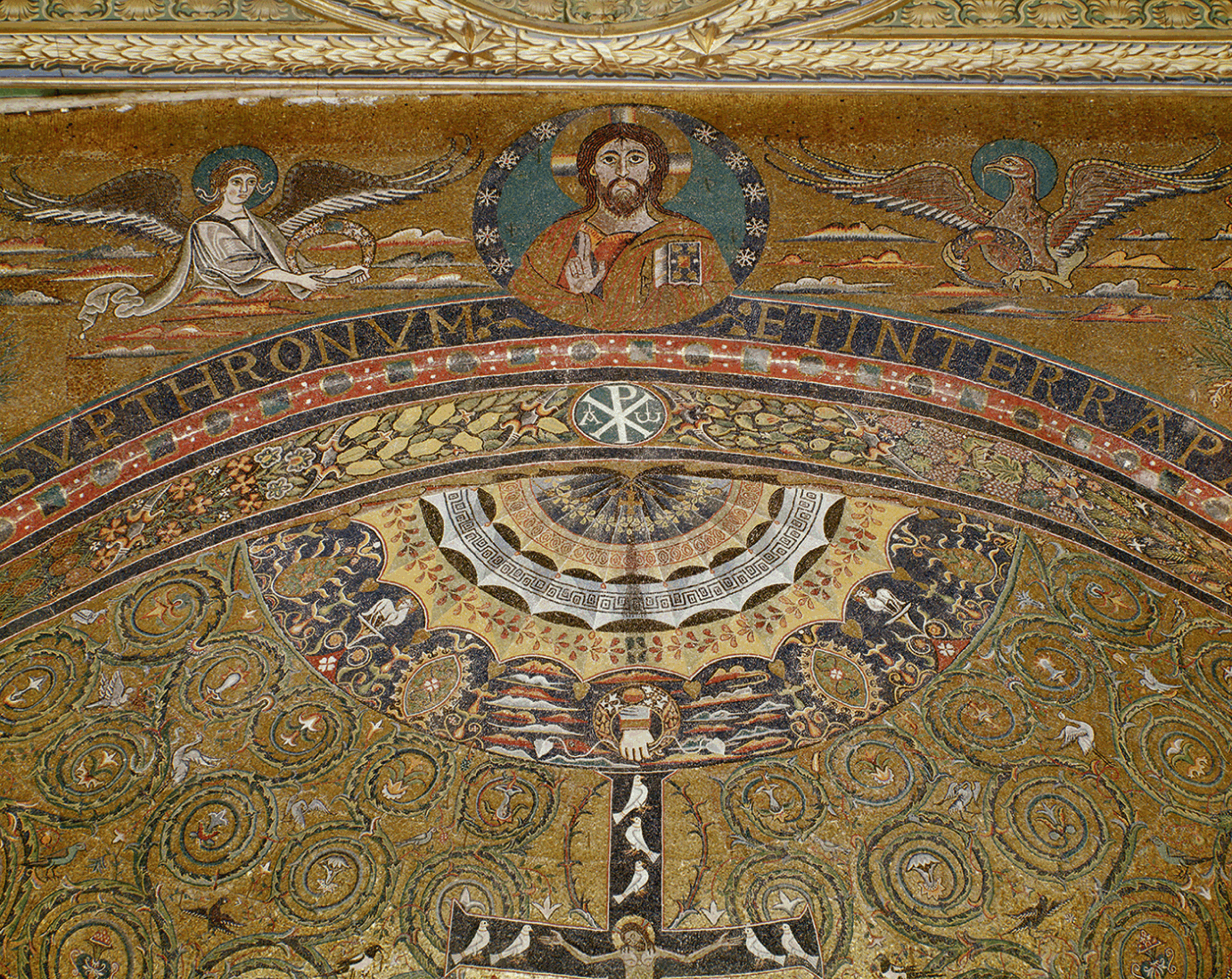
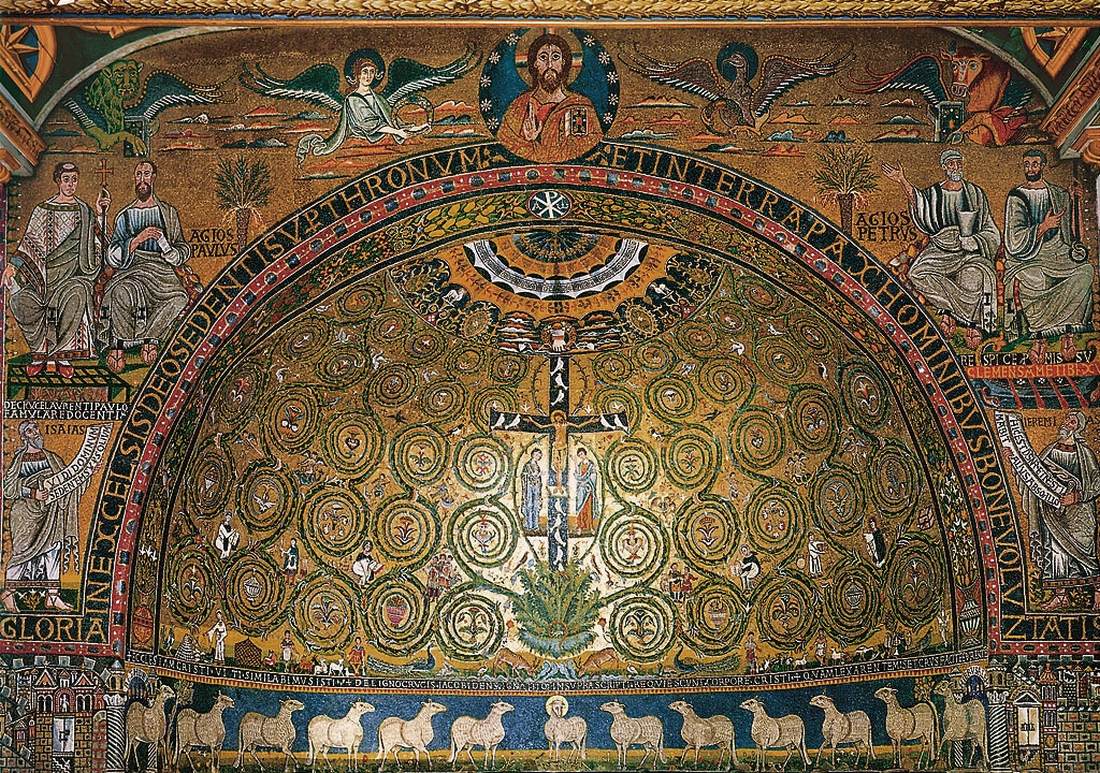
An apse is a half of a domed roof. The Tree of Life is found in the Church of San Clemente in Rome.
The Mosaic is filled with symbolism. First watch the video about it and then after look below where the mosaic is broken up into sections.
TASK – write down as many different bits of symbolism as you can to keep your attention up as you watch the video. Check below to see how many you got right!
The Cross and the Tree
HADAD
TASK – LEARN WHAT EACH LETTER STANDS FOR. REPEAT. TRY WRITING DOWN EACH LETTER AND SEEING HOW MANY YOU GET RIGHT
Healing
At the base of the cross is the tree of, considered to be the tree of life. This is a reference from Revelation 22:2 “on either side of the river, the tree of life with its twelve kinds of fruit, yielding its fruit each month; and the leaves of the tree were for the healing of the nations”
Similar to the crucifixion saving all people of all nations from their sins, the leaves of the tree of life heal all nations.
All Humanity
The cross seems to emerge out of the tree of life and is then wrapped with the vines. Branching out from the tree on both sides are swirling vines that cover the entire mosaic branching out to all humanity.
Christ reached out to all humanity by dying on the cross for our sins. This act heals the world of its sin and suffering and spreads across the whole world for us.
Death
The cross is the crucifixion scene
Religious people will see the cross as a symbol of the death of Christ. He did this for immense good. He did this to absolve humanity of their sins.
Mary and John stand either side
The Hand of God the Father above offering a wreath of victory to Christ.
Adam
The tree is also a reminder of Adam and Eve in the Garden of Eden. They ate the fruit bringing sin and death into the world.
Jesus reverses the disobedience of Adam by being obedient to God and offering his life on the cross.
St Paul writes about this calling Jesus the new Adam. Adam went against God and brought pain, suffering and sin to the world. Jesus was faithful to God and brought a way back to God and a new way to be human.
Dove
The apostles are here represented as doves surrounding Jesus on the cross (they are shown in several different ways in the mosaic)
Doves are a symbol of piece and a sign of the Holy Spirit filling the earth on Pentecost
Alpha and omega and Chi-Ro
Above the cross is a symbol that looks like a white P and X written on top of each other. This is the Chi-Rho symbol. Either side of this are the Greek letters alpha and omega.
Chi-Rho
The P and X are the first two letters of the word Christ in Greek. Is is a very early symbol of Christianity and can be viewed as the first Christian cross.
Alpha and Omega
These are the first and last letter of the Greek alphabet. This reminds Christians that God is the beginning and the end of all things. In the Book of Revelation God speaks of himself as the alpha and omega. From early Christian times it was also used to refer to Jesus. This reminds us that Jesus is eternal because he is God.
TASK – MEMORISE AND REPEAT. TRY WRITING DOWN EACH POINT AND SEEING IF YOU GET IT RIGHT
The Lamb
At the bottom of the cross their are 12 lambs who are facing towards a lamb at the centre of the picture directly under the cross. This central lam is the ‘lamb of God’ or Jesus.
SPADE
TASK – LEARN WHAT EACH LETTER STANDS FOR. REPEAT. TRY WRITING DOWN EACH LETTER AND SEEING HOW MANY YOU GET RIGHT
SACRIFICE – The lamb is a symbol of sacrifice
PASSOVER – In the passover story a lamb was sacrificed (killed for the good of others) and its blood put on the door posts of the Israelites. The Angel of Death ‘passed over’ these hoses and instead killed the first born sons of the Egyptians.
APOSTLES – 12 lambs are the apostles. They also lived a life of sacrifice. They gave up their homes and families to follow Jesus and spread the word after his death.
DEATH – Jesus is described as the ‘lamb of God’ because his death on the cross saved humanity from their sin and death, just like the sacrificed lamb had saved the Israelites.
END AND BEGINNING – Beginning to End. The 12 apostles come from Bethlehem the place of Jesus’ birth and Jerusalem the place of Jesus’ crucifixion.
The Four Apostles
Above the dome are the symbols of the four evangelists – Matthew, Mark, Luke and John.
TASK – DRAW EACH SYMBOL FROM MEMORY AND WRITE DOWN WHAT IT MEANS
Left to Right
WINGED LION – MARK – Signifies leadership and royalty. This is seen as a symbol for Christ the KING!
THE MAN – MATTHEW – Matthew is the Gospel about Christ’s humanity and his humbleness and humility are highlighted throughout the book.
THE FLYING EAGLE – JOHN – This book is unlike the other gospels in that it begins with a theological meditation (wondering) upon the meaning of the fact of Christ.
WINGED OX – LUKE – An Ox was used in sacrifice in the Temple. The winged ox is a reminder of the priestly character of Jesus and of his sacrificial death for the sings of all mankind.
TASK – LOOK AT THIS PICTURE. CAN YOU IDENTIFY EACH PIECE OF SYMBOLISM?
RED ZONE
Describe the symbolism of the cross and the tree in the Tree of Life Apse Mosaic
Describe the symbolism of Alpha and Omega and Chi-Rho in the Tree of Life Apse Mosaic
Describe the symbolism of the lamb in the Tree of Life Apse Mosaic
Describe the symbolism of the four evangelists in the Tree of Life Apse Mosaic
Explain why Jesus is sometimes called the ‘new Adam’
‘The Tree of Life Apse Mosaic is the bible symbolised in art’ discuss possible views on this statement.
Which piece of art could Christians think of as more important. The Creation of Adam or The Tree of Life Apse Mosaic?
Part of Catholics response to evil and suffering being a “problem” that proves God doesn’t exist is to talk about Human free will.
In the Garden of Eden God did not want humans to eat from the tree of knowledge. Adam and Eve were told not to. However God also gave them free will and gave them the choice. They chose to go against God.
It is how we use our free will that causes evil and suffering and if we made better choices there would be less evil and suffering – it is not God’s fault.
This means Christians do not feel strongly that evil is a problem that proves God does not exist. They are ambivalent towards this argument. It doesn’t really bother them.
CATHOLIC AMBIVALENCE = GASBAR
G – Gift
Free will is a gift from God. It gives us freedom and means we are not forced to follow him. God loves us so gives us freedom.
A – Ability to Choose
God created man with the ability to choose between good and evil.
S – Suffering
When humans choose the wrong thing it causes suffering. Therefore evil and suffering is caused by man not God.
B – Blame
Humans are to blame for making the wrong choice not God. We could choose the right path which leads to less or no evil and suffering in the world.
A – Abused our Gift
Humans have abused the gift God gave them. We abused the freedom we were given in the Garden of Eden and we continue to abuse the gifts of creation that God gave us out of love. This is the source of the evil and suffering in the world.
R – Robots
Humans are not programmed robots. We are not given a set behaviour by our creator but we are given the gift of free will to choose for ourselves.
TASK – Learn each letter of the Acrostic GASBAR. Write them down over and over until you get them correct.
RED ZONE
Describe what is meant by Catholic ambivalence towards evil and suffering
Explain why a Catholic may not believe evil and suffering is caused by God but by human free will
“Christians believe God is not to blame for evil in the world.” What are the two different arguments to this statement?
The story of Genesis tells us how the world was created.
Genesis 1 – The Days of creation
Genesis 2 – Adam and Eve
Genesis 3 – Original Sin and the Fall
Straight away the Bible explains why God’s perfect creation was ruined. How humans let bad things into the world.
So when atheists use the problem of evil as an argument God doesn’t exist the immediate Christian response is that God didn’t create a world with evil in – we let it in by making a very bad decision.
TASK – Watch the video’s below and then write your own story board or bullet point list over what happens in Genesis 3
O – Opposite
What happened was the opposite of God’s command
R – Reminder of Responsibility
The story is in Genesis as a reminder we all share responsibility. It was not God who caused evil and suffering but it was human kind that caused it.
I – 1st
This is the 1st time man goes against God. It is the first sin. The original sin
G – Genesis 3
Book in the Bible where the story is form
I – Ignore
We all now can doubt God and have a little piece of our mind that goes against God because of this time we ignored God. It is why we now doubt.
N – Not God’s Plan
It was not God’s plan for Adam and Eve to eat the fruit from the Tree of Knowledge. He explicitly did not want it to happen. He specifically said not to.
A – Adam and Eve
Adam and Eve decided to eat the forbidden fruit going against God’s wishes
L – Lets evil into the world
Lets Natural Evil (hurricanes and earthquakes) and Man Made/Moral Evil into the world
S – Snake
The snake tempts Eve by telling her to eat the fruit. This shows how we must resist temptation to do bad things.
I – In the Garden of Eden
The Garden of Eden was the perfect world God created for us. Even in this perfect world humans still made a poor decision resulting in evil coming in to the world.
N – kNowledge
Adam and Eve gained knowledge from eating the fruit. They realised they were naked and felt shame. The covered themselves with branches.
TASK – MEMORISE THE ACROSTIC MEMORY DEVICE ABOVE. LEARNING AND REMEMBERING WHAT EACH LETTER STANDS FOR.
TEST YOURSELF – WRITE OUT EACH LETTER IN ORIGINAL SIN DOWN THE SIDE OF A SHEET OF PAPER AND TRY TO FILL IT IN. KEEP GOING UNTIL YOU REMEMBER THEM ALL




 Mr Fox's Online RE Classroom